
AI Fusion Heating became a more concrete research target in July 2026, when the U.S. Department of Energy selected Princeton Plasma Physics Laboratory to lead a Genesis Mission project on an AI operator for electron cyclotron heating systems. The broader Genesis Mission had been launched by DOE in November 2025 to use artificial intelligence for scientific discovery, national security, and energy innovation, according to the DOE announcement. The fusion heating project sits within that larger federal effort, but it remains a research program rather than a demonstrated power-plant technology.
The specific PPPL-led effort focused on creating a digital twin of beam-wave interactions inside a gyrotron, a high-power microwave source used in electron cyclotron heating, according to the PPPL release. In practical terms, the project aimed to build a virtual representation that could help study and eventually guide how heating equipment behaves. That is a narrower and more testable goal than the common public phrase fusion breakthrough, and it deserves analysis on those terms.
What AI Fusion Heating Means In Genesis
Why AI Fusion Heating Centers On ECH
Electron cyclotron heating, often shortened to ECH, is used in fusion energy research to deliver high-power microwave energy through systems that include gyrotrons. The PPPL project did not claim that AI would solve fusion energy by itself. Instead, it targeted a component-level challenge: understanding beam-wave interactions inside a gyrotron well enough to support an AI operator. That distinction matters because fusion energy depends on many subsystems, while this project addressed one heating-related system.
For AI Fusion Heating, the immediate scientific question is whether a machine-learning system, supported by a digital twin, can improve the way researchers model, test, or stabilize heating behavior. The available announcements did not provide experimental performance data, error rates, time savings, or cost estimates. They described a planned research pathway. A cautious reading is that the work could improve control research for heating systems, while proof will depend on validation against physical experiments and operational requirements.
What The Genesis Mission Added
The Genesis Mission supplied the programmatic frame: AI systems, computing infrastructure, experimental facilities, and datasets were being brought together for scientific domains that included fusion energy, advanced nuclear systems, materials discovery, quantum science, and national security applications. That structure is relevant because a digital twin for a gyrotron may require both domain-specific physics knowledge and significant computing support.
The public value of the mission will depend on whether these linked resources produce reliable scientific outputs rather than only faster software demonstrations. Large AI initiatives also carry energy and infrastructure questions of their own; our related analysis of AI power demand examined why computing needs have become a serious consideration for next-generation AI research.
How The PPPL Project Is Structured
The Gyrotron Digital Twin
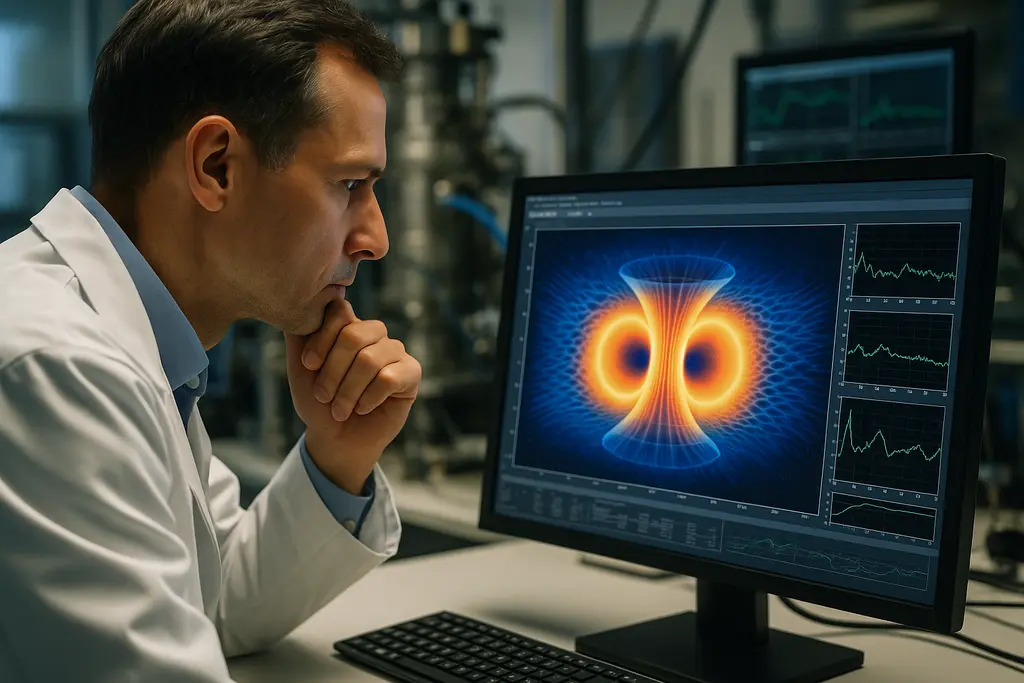
The central technical object in the PPPL-led project was a digital twin, meaning a virtual replica of the beam-wave interactions inside a gyrotron. The research notes identify the gyrotron as a high-power microwave source used in ECH systems. A digital twin in this context is not a complete virtual fusion reactor. It is a focused model of interactions within a key heating device.
That focus is scientifically useful because heating systems need predictable behavior before any AI operator can be trusted in research settings. If the model fails to represent important device behavior, an AI system trained or guided by that model may make recommendations that do not hold up in experiments. The announcements did not say that this validation had already been completed as of August 18, 2026.
Collaborators And Division Of Work
The collaborators named for the project were Rice University, the Naval Research Laboratory, Brookhaven National Laboratory, and Sophelio. The published notes did not provide a detailed task breakdown for each organization, so assigning specific responsibilities would go beyond the evidence. What can be said is that the team brought together national laboratory, university, defense laboratory, and private-sector participants under the Genesis Mission framework.
This mix is consistent with the mission’s public-private approach to AI-driven science, but institutional breadth alone does not establish technical success. Multi-partner projects often gain access to wider expertise, yet they also need clear interfaces between physics models, data systems, and operational goals. The available material did not specify a deployment date for an AI operator in a working fusion experiment.
Evidence Gaps And Implementation Barriers
What Has Not Yet Been Shown
Claims about AI Fusion Heating should be separated into what was announced and what remains unproven. The announced work was a project to create a digital twin and develop an AI operator for an ECH-related system. The unproven part is whether such an operator will reduce design time, improve stability, or scale across different heating configurations. Those outcomes may be goals, but the research notes did not provide measured results.
The project should therefore be treated as early-stage applied research. It is more advanced than a purely theoretical proposal because it names a target device class, partner institutions, and a model-building approach. It is not commercialized fusion technology, and it is not evidence that practical fusion power has arrived. That distinction is central for readers assessing public claims about AI in energy research.
Validation, Safety, And Control Questions
Any AI operator proposed for scientific equipment would need evidence that it behaves reliably under relevant operating conditions. The research notes did not describe safety protocols, regulatory pathways, benchmark datasets, or human oversight arrangements. Those omissions do not imply that the project lacks such plans; they mean the public evidence available here is not enough to evaluate them.
The largest implementation barrier may be the gap between an accurate digital twin and dependable real-world control. A virtual model can be useful for simulation and training, but physical systems may expose unexpected behavior. Researchers will need to show that model predictions match experimental observations closely enough to justify greater operational use. Until then, AI should be viewed as a research accelerator and decision-support tool, not an autonomous solution for fusion energy.
Why The Timing Matters For Energy Research

AI Science Meets Fusion Hardware
The timing is notable because DOE placed this fusion heating work inside a larger national push for AI-enabled science. Fusion research has long required high-end computation, specialized facilities, and large datasets. The Genesis Mission attempted to bind those assets more closely to AI systems, with the stated aim of accelerating discovery across major scientific areas.
For fusion heating, that could mean faster iteration between simulation and experiment. A digital twin may let researchers test hypotheses about gyrotron behavior before conducting physical experiments. Still, faster iteration is not the same as verified improvement. The quality of the model, the relevance of training data, and the standards used to evaluate the AI operator will determine whether the approach has scientific value.
Public Communication Needs Precision
Fusion energy attracts strong public interest because of its long-term promise, but public communication often compresses many technical steps into a single narrative. A project on heating-system control should not be described as a near-term power source. It is one piece of a much larger research chain.
Science outlets and related sites, including the Li Live Steam network site, have a responsibility to avoid overstating preliminary work. The careful version of the story is still significant: DOE and PPPL were applying AI to a specific fusion heating challenge, with a digital twin of gyrotron interactions as the technical starting point.
AI Fusion Heating Under The Genesis Mission
A Measured Reading Of The Project
AI Fusion Heating under the Genesis Mission is best understood as a targeted attempt to improve research tools for electron cyclotron heating, not as proof of a finished fusion-energy system. The PPPL-led project offered a defined technical path: model beam-wave interactions inside a gyrotron, use that model to support an AI operator, and test whether the approach can improve heating-system research.
The reason it matters is that heating systems are central to fusion experiments, and better modeling may help researchers move more efficiently through design and testing cycles. The reason for caution is just as clear: the public record described aims and participants, not verified performance gains. As of August 18, 2026, the strongest evidence supports the existence and scope of the project. The stronger claims, including major reductions in reactor design time or broad improvements in fusion stability, still require published results and independent assessment.